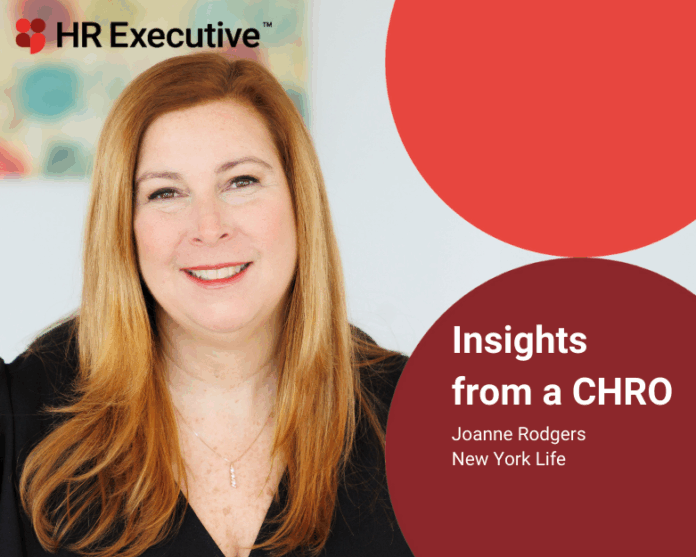
On the day that Joanne Rodgers, senior vice president and CHRO at New York Life, sat for an interview with HR Executive, she and her team were headed off-site for a focused brainstorming session on how they could continue to innovate in HR with AI.
It’s work that’s already well underway at the firm, the largest mutual life insurance company in the U.S., which employs more than 12,000 people. For instance, last month, the organization launched Career Hub, a career growth platform that encourages internal mobility and provides skills-building opportunities, including through gig projects. The AI-powered tool, Rodgers says, embodies the organization’s goal of modernizing how the workforce learns, grows and experiences employment with New York Life.
It’s an experience Rodgers knows well: She joined the organization in 1994, moving throughout departments and roles. She recently shared with HR Executive what her own journey has been like, and how she envisions efforts like Career Hub will provide other employees with similar paths.
HR Executive: How does your own journey with New York Life reflect its investment in its people?
Rodgers: I love this company; I’m the luckiest person in the world. I have a job where I can help support the people and culture of this organization. Before I came into the organization, I was a securities regulator. When I joined, I started in the compliance department. That was my technical expertise. Then I spent time in corporate strategy and ended up in HR. Looking backward now, it all makes sense how I got here—but sitting in compliance back then, I don’t think I would have been able to see how those skills would have opened up this pathway for me.
That’s what I’m hoping Career Hub can unleash—the art of the possible—for our employees. At New York Life, sometimes people can see the potential you can’t see in yourself yet, and this is a way to create those opportunities, give feedback and provide that care that can help people grow.
HR Executive: What was the impetus for Career Hub?
Rodgers: Obviously, investing in our employees is always at the forefront. For us, taking this new approach was about modernizing the employee experience. [Career Hub] is not just the traditional classroom or online learning; it’s about putting the art of the possible in our employees’ hands. It’s a way to explore how the skills they have today can actually open up some other possibilities and career paths for themselves. And it’s about providing highly curated upskilling opportunities for employees, whether they choose to stay in the lane they’re in today or in another one they want to explore. It’s a more modern, fresh look at investing in employees.
HR Executive: What stakeholders did you work with to design and roll out the program?
Rodgers: We’re at our best when we’re a cross-functional organization. We worked with so many departments across the organization. The closest ones were tech, marketing, communications. Change management was really important. You can build a field of dreams, but if people aren’t showing up, you don’t really know the effect. We had to make sure our investment was understood by employees. We worked with an external vendor, eightfold.ai, which brought a new opportunity for us to collaborate.
HR Executive: What has the response been?
Rodgers: Feedback has been great. What’s exciting about Career Hub, and that people really love, is that it feels like Amazon. It’s intuitive to navigate. And that helps the uptake. We started off with a pilot to make sure we got it right with three departments, and HR was one of them. We set a 70% adoption goal—for people to go in and create a profile and explore the tool, and I’m happy to report we exceeded that, with 74%.
We rolled it out to the whole enterprise, and we’ve had 5,000 people create profiles, which is about 40% of the organization. Especially to see that level of adoption in August—which is an interesting month, with people taking vacations—really highlights the importance of change management. Our team was incredibly thoughtful in our partnerships with marketing and communications; we have people walking around with Career Hub notebooks, everybody got a plant and messaging about what growth can look like. We tried to be really thoughtful and creative.
HR Executive: How do you intend to measure success when it comes to Career Hub?
Rodgers: Internal mobility has been a real focus opportunity for New York Life, and I think we’d like to continue to see growth there. There is also the concept of gig work that we’re looking at. Employees can go into the Hub and apply for a very short, time-bound experience or project. We’re seeing people engaging in these gig experiences that will be really valuable. We’re going to see how people will grow their skills by stepping out of their lane.
HR Executive: Had there been gig opportunities prior to Career Hub?
Rodgers: It happened in pockets. But now, there’s greater access and greater visibility. For instance, in our finance team, someone in vendor management had a project that was time-bound, with aggressive deliverables, and they needed support. They put out a gig and had people apply from all over finance. Three people ended up stepping in, collaborating, and they were able to take advantage of skill sets they likely wouldn’t have known existed within their own department.
HR Executive: In what ways are you working to strengthen a culture that encourages employees to grow with the company?
Rodgers: We’re really focusing on building a growth mindset across all of our employees and managers. Growth is in a lot of our vernacular. We have an [employee development] ecosystem called Empower Your Growth, and Career Hub is at the center of that. There is also Impact, which is our performance management program. We recognize that, with AI emerging, it’s important for our employees to have these skills, so we added an AI goal as part of Impact.
We’re investing in upskilling and really focusing on the mindset, skillset and toolset as it relates to AI; [AI upskilling program] Ignite AI is part of our Empower Your Growth. We’re also investing in our managers, who play a critical role in supporting the growth of our employees.
HR Executive: How are you thinking about AI’s potential role in HR processes at New York Life?
Rodgers: AI is at the forefront, not just in HR but within the organization more broadly. We have [AI-powered] coaching for leaders. We’ve invested in homegrown GPTs, and I’m really proud to say HR has the highest-level enterprise utilization of a GPT the team created right now. AI is helping us be more effective in doing performance evaluations and giving feedback to employees. It’s helping managers think more about strengths and opportunities for employees. It’s making the experience better for managers and employees.
See also: An expert’s 5 pillars for successful AI implementation
We’re using AI in a very targeted way—hitting small components of a process. But what we’re shifting to now in HR is reinventing domains. For instance, we’re looking at the recruiting process and how we can leverage AI from beginning to end—not just in step 2 or step 10.
HR Executive: What are the most significant pain points you have run up against, or envision you might encounter, in integrating AI into HR or across the workforce?
Rodgers: How comfortable people are [with AI] runs the gamut. Some are really leaning in, and some are more cautious. That’s why we’re so focused on raising the skills of all employees. We do this through Ignite AI, and we have a partnership with Conor Grennan, New York University Stern’s chief AI architect, who also owns AI Mindset. He’s doing a lot of work on the idea that technology is just a tool; [AI integration] is really about the people and how they can adapt and embrace it and change how they think.
We’ve rolled out a lot of tools, and now we’re focused on how to continue to embrace adoption.