

What excites Jackie Dube most is the potential for HR leaders to see a full, connected view of their people: what drives them, how they grow and where they thrive.
But that vision remains distant for most organizations. Most performance reviews still focus on documenting the past rather than developing for the future, a flaw that leaves employees frustrated and managers overwhelmed with paperwork instead of having meaningful conversations.

Dube, chief people officer at workplace behavioral assessment solution The Predictive Index, believes technology can help shift that dynamic by surfacing insights that guide growth and removing manual work that bogs down managers.
When annual performance reviews fail
The cost of this broken system is steep. “Employers are emphasizing productivity above all else,” according to Stacia Garr, co-founder of analyst firm RedThread Research.
However, as she wrote in a recent release, this push has “not actually translated into any better outcomes,” as most employees report dissatisfaction with performance management and fairness, highlighting a deepening trust issue in organizations.
Another potential outcome begins with reexamining performance touchpoints. According to recent research by consultancy firm WTW, nearly half of approximately 280 HR professionals surveyed believe that optimizing the performance management process could boost productivity by at least 10%.
While employers recognize that employees expect clear goals and priorities, regular feedback, fair ratings and strong links to rewards, WTW found that only 39% of organizations feel their performance management process effectively meets these expectations.
Traditional annual reviews miss early warning signs that employees are struggling or disengaging. Dube highlights subtle shifts that often go unnoticed, such as reduced collaboration, changes in communication tone or missed development milestones.
These small signals can easily slip through the cracks if not carefully observed. When combined with behavioral insights, they give managers a clearer grasp of the human factors behind performance dips. This understanding allows managers to intervene early, preventing issues from escalating into turnover.
By the time problems surface in a formal review, it’s often too late.
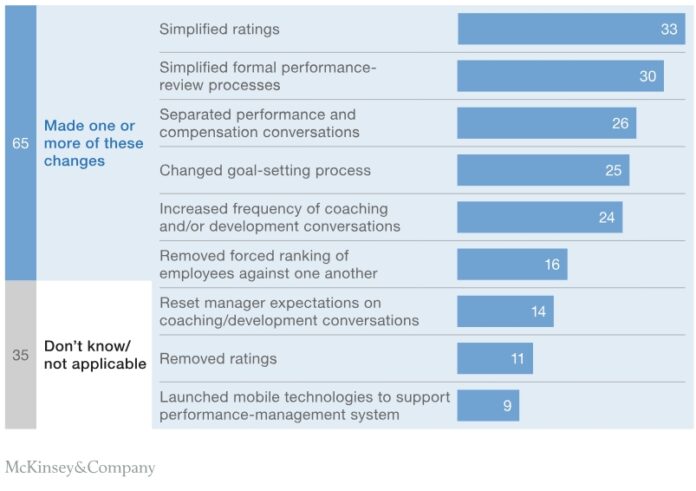
McKinsey’s research on reviews found that 60% of respondents who consider their company’s performance management system effective reported that their organization outperformed its peers over the past three years. That’s nearly three times the proportion of those who view their system as ineffective.
“Instead of asking, ‘What did you achieve?’ the conversation becomes, ‘What are you capable of next, and what support do you need to get there?’ ” Dube says.
Enhancing judgment, not replacing it
Although manager feedback is the most commonly used data source in evaluations, WTW found that only 20% of organizations consider managers effective at coaching and giving feedback. This reveals a significant gap between reliance on manager input and its actual impact.
Many employers are turning to technology to help with this.
A recent Resume Now survey suggests that many workers see potential benefits in AI, at least in some situations. The report, based on responses from over 900 U.S. workers, found that 66% believe AI-led management could make the workplace fairer and more efficient.
However, even in a tech-supported workplace, the goal should not be to replace human judgment. By handling data-intensive work like transcribing conversations, organizing notes or identifying trends, technology frees managers to focus on the person rather than the paperwork.
“Being human-first means recognizing that performance management isn’t a one-size-fits-all,” says Dube. “Every employee processes feedback differently, is motivated by distinct drivers and responds uniquely to varying levels of structure and autonomy.”
That understanding allows managers to adapt their approach to each person’s needs, which is where trust and empathy take root.

The path to continuous feedback
But introducing new technology into performance management requires careful guardrails. Dube emphasizes that transparency should be the cornerstone of any data-driven performance process.
“Employees deserve to know how AI is being used, what data is collected and how those insights will inform decisions,” she says. “If your organization hasn’t yet created a culture of open dialogue around AI, it’s worth pausing before introducing these tools into performance management.”
A recent survey by The Predictive Index highlights a concerning gap: Seventy-one percent of employees feel safe discussing AI at work. Yet nearly half believe their input doesn’t influence how it’s adopted.
“That disconnect underscores the need for openness,” Dube says. “Employees want to understand how data informs their reviews and how their feedback is used, not just be told that ‘AI is helping.’ ”
HR leaders should establish clear data governance policies, define who has access to generated insights and ensure all algorithms are auditable and explainable. Regular reviews with IT and legal teams help validate that tools meet privacy and compliance standards.
Starting small, scaling smart
For HR teams just beginning to explore new approaches, Dube recommends starting small and acknowledging that people experience change differently.
“Pilot AI tools with a few managers who are open to change, using them to reduce administrative load,” she says. Focus on tasks such as summarizing feedback or tracking goals, rather than making evaluative judgments. Then, use early wins to show what improved performance looks like.
The ultimate goal is moving from annual reviews to continuous, real-time feedback. Technology automatically captures performance signals and provides timely insights. This enables managers to hold smaller, more frequent check-ins throughout the year.
“Instead of one high-stakes conversation at year’s end, employees receive ongoing dialogue about their growth, which builds momentum, trust and alignment throughout the year,” says Dube.
“It helps every manager show up better prepared, every employee feel more understood and every organization build systems that turn performance reviews into genuine growth engines,” she says. “That’s how we rebuild trust, conversation by conversation.”

