

HR leaders navigating 2026 face what the new Employ Hiring Benchmarks Report calls “planning for the unpredictable.” The report from Employ’s family of ATS solutions (Jobvite, Lever and JazzHR) analyzed data from 6,640 organizations across five industries to answer a critical question: What does great hiring look like today and how do we get there?
The answer isn’t what most HR teams expect. Rather than trying to improve every metric at once, the report makes a case for strategic focus on one or two high-impact changes.
Hiring in 2026
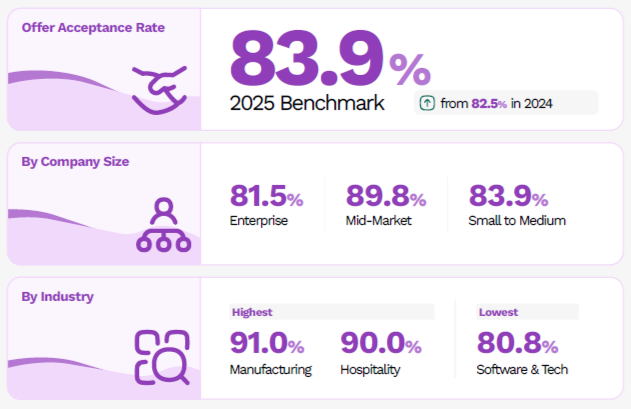
The report identifies four metrics that require urgent attention: qualified applicant rates, time to screen, screen-to-interview rates and offer acceptance rates. Each reveals different bottlenecks in the hiring funnel.
The data reveals overall shifts since 2024. Applicant volumes jumped 24%, from 207 to 258 applications per job, while time to fill improved from 67 to 63 days. However, not all trends moved in a positive direction. Early retention slipped from around 94% to 85%, while candidate experience scores held flat.
The report emphasizes that context matters. “When the market shifts, so do hiring benchmarks, and the teams that adapt fastest are the ones that win,” according to the introduction. Software and tech companies attract 369 applications per job on average, while manufacturing sees just 176. Enterprises move candidates to interviews in around six days, while small businesses take around eight days.
These variations mean HR leaders can’t simply copy another organization‘s playbook. They need to understand their own metrics first.
The strategic approach to benchmarking
The report breaks hiring into five stages: attract and engage, screen, interview, select, and onboard. Each stage includes specific benchmarks that vary by company size and industry. The report argues against the common “fix everything” approach that leads to scattered efforts and minimal progress.
“Whether you’re looking to tighten your funnel, make a stronger business case for new tech or simply benchmark your team’s performance, this is your roadmap,” the report states.
The most valuable insights come from understanding which improvements create ripple effects across multiple stages, according to the research. For example, the report found that better screening processes don’t just reduce time to screen. They also improve interview-to-offer rates and candidate experience scores.
What the data reveals about common problems
Organizations struggle with different challenges, depending on their size and industry. The report’s breakdown by company size shows enterprises convert around 47% of screened candidates to interviews, compared to approximately 24% at small businesses. This gap reflects differences in resources, processes and technology access.
Candidate experience presents a universal challenge. Enterprises score lowest, despite having more recruitment marketing resources, while mid-market and small businesses score slightly better. The report suggests scale makes personalization harder, even with bigger budgets.
Industry patterns also emerge from the data. Hospitality moves fastest, with less than seven days to screen and 40 days to hire. Software and tech take longer, at nine days to screen and 51 days to hire, reflecting the complexity of specialized roles. Retail sees the highest engagement rates at 7%, while business services lag at around 4%.
The diversity data shows progress, but also persistent gaps. Overall applicant diversity improved from 41% to 46%; however, enterprises continue to see the lowest share of diverse applicants at 27%, compared to 58% at small businesses. The report hints that brand perception plays a significant role in these disparities.
Turning hiring benchmarks into action
The report emphasizes the importance of choosing one quick win and one strategic initiative, rather than launching multiple projects simultaneously. For HR leaders overwhelmed by the volume of data and competing priorities, the report offers a framework: Assess your flow across all stages, prioritize the biggest wins and track progress iteratively.
The report closes with a reminder that metrics tell stories about workflow efficiency, team alignment and candidate experience. “The patterns you uncover are the blueprint for your 2026 hiring strategy,” according to the final section.

