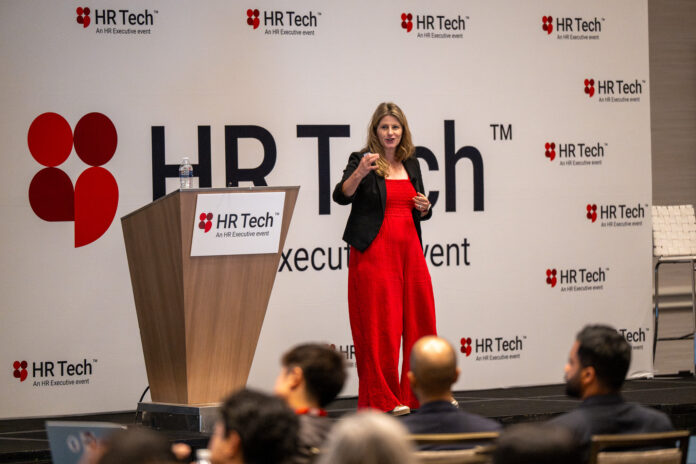
HR leaders are standing at a pivotal juncture; it’s like seeing a giant dust storm in the distance that is getting ready to collapse and fill the air, analogized RedThread Research’s Stacia Garr on Wednesday at HR Tech in Las Vegas.
What’s spewing in that air? AI, skills gaps, employee turnover—a general sense of uncertainty, she said.
Now, the question is, what can HR do to ensure it doesn’t have to “pull over” to get through that storm—but rather can drive right through it?
5 megatrends HR leaders have to prepare for
Garr said HR needs to understand the context of what’s facing the function—and how teams can prepare, protect their people and pivot their strategies—from five looming megatrends:
1. Global instability
Geopolitical crises are a real threat today, but few organizations—and HR functions—are ready.

“More CHROs are prepared for natural disasters than they are for a geopolitical crisis,” despite the latter being “very, very real,” she said, citing conflicts between Ukraine and Russia, and Israel and Palestine.
Garr advised HR leaders to track such tensions, shore up emergency contact data and get ahead of setting and approving hardship pay. Think ahead by developing HR runbooks to scenario plan, and strategize in case the organization needs to relocate employees: How will you handle identification checks and manage cross-border data?
From payroll solutions to labor market intelligence tools, “there’s a lot of tech that can help you with this,” she said.
2. More growth—but less of a people focus
In the last few years, CEOs have been increasingly prioritizing company growth—but de-emphasizing their focus on people.
Garr cited recent Gartner research that showed 56% of CEOs said growth is their top priority; only 21% cited their workforce, putting it fifth on the list of concerns.
“What’s important here is not just that workers are at the bottom of that heap; it’s that in years past, they’ve not been,” she said, citing “pretty significant shifting” in CEO priorities. Yet, headcount likely won’t drive growth; 73% of CEOs aren’t planning to expand their workforce, according to The Conference Board. That’s placing even more onus on HR.
“We are the ones who have to hold up what people need,” she said.
HR needs to model the real cost of growth—including how unmanageable workloads could drive burnout or turnover. Look ahead to surface hotspots and connect employees with growth-oriented opportunities.
AI can take away some work from managers, but HR leaders need to lean in to ensure the integration of tech is clearing up their plates in the actual day-to-day. HR can also look to data to assess the state of growth, productivity and wellbeing—such as how much PTO employees are taking or health conditions on the rise.
Talent mobility and rewards driven by culture can also build an infrastructure of support, she added.
3. Power struggles continue
According to the Edelman Trust Barometer, trust is down on both sides of the employee-employer relationship. This is being complicated by disparities in how leadership and individual contributors think about remote work and the sudden downturn in corporate attention to DEIB—and evidenced in the rise of union support, now at its highest level in about 60 years, Garr said.
HR needs to assess where the state of trust is, what the company is or isn’t doing to strengthen it and identify early signs of disengagement. Educate leaders on tensions, she advised, and double down on employee listening. Ensure workers understand what company policies mean—from return-to-office to digital surveillance—and support DEIB, even if you do it “without labels.”
Embed equity across core processes, Garr noted, and empower employees to have a voice.
4. Population and skills mismatch
It’s no secret that a smaller percentage of the American population is working, with Baby Boomer retirement surging and fertility rates low.
“We’re not going to have the people to do the work,” Garr said. So, she said, the answer is clear: “We’ve got to rethink how work gets done.”
That will mean understanding workforce skills and mapping them to jobs and roles, while doing the same for critical tasks. Eliminate and consolidate low-value tasks, while looking to the future to understand emerging gaps and opportunities between skills and tasks.
Let workers have a say in automation decisions as the organization redesigns and redeploys talent, based on the alignment between tasks and skills.
5. More AI use cases—fewer experiments
Bottom-up experimentation—common as organizations have empowered their employees to embrace AI over the last few years—has a place in the future, Garr said. They can be great idea generators and culture builders, but they’re not effective for systemic change that has a significant impact.
“We’re going to see a shift toward more AI use cases that are going to drive value,” she said.
Establish how to measure such efforts, guard against inequities and prepare managers for how their roles will shift, she advised. Keep potential culture impacts on the radar and redesign decision rights as AI integrates into processes.
At the same time, HR needs to be the people-centric voice of the C-suite; this remains an entirely human-oriented task, she said.
“I don’t think there’s tech out there to help you champion human impact at the executive table,” she said. “It’s up to each and every one of you.”