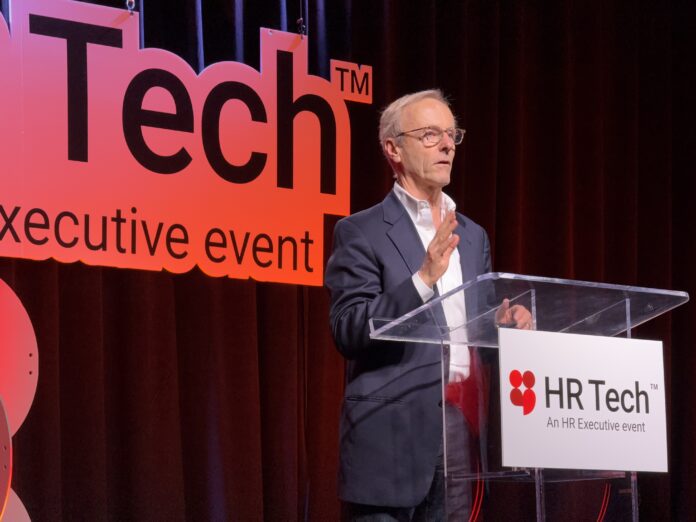
Maximizing the opportunities of AI transformation—and confronting the challenges it presents—drove the majority of discussion at HR Tech this week, including by leading industry analyst Josh Bersin.
In his closing keynote on Thursday, Bersin said HR is at a critical moment, with an HR tech market that is being revolutionized and a new mandate to re-envision how work of the future is done.
What does AI transformation look like?
AI transformation is currently happening in four phases, Bersin said:
- Assistance: Employees are leveraging tools like ChatGPT and Galileo for individual parts of their jobs, typically finding 15%-30% improvements.
- Automation: As the workforce becomes more comfortable interacting with such tools, organizations are redesigning jobs to flow tasks to both humans and agents, improving processes by up to 50%.
- Multi-function agents: As multiple agents are deployed, organizations can fully “re-engineer jobs,” stitching together processes across functions, and boosting improvements of 100%-200%.
- Autonomy: At this end stage, organizations can reap up to 300% in improvements, as AI agents manage the work—and humans manage the agents, Bersin said.
5 takes on the implications of AI transformation
As companies progress through this journey, it’s reshaping the job market and driving the ongoing consolidation of HR tech companies, with the biggest players vying to become leading AI transformation firms, Bersin said.
See also: Amid rapid change, why HR has to embrace ‘positive disruption’
His perspectives on this shifting landscape include:
AI is not really taking all the jobs
While AI transformation is often in the headlines as a driver of job losses, Bersin said, the root is more that organizations are slowing their hiring spend as they anticipate increased investments in AI. At the same time, he said, some firms may be pointing the finger at AI for headcount reductions—but just using the moment to address already-existing financial concerns.
You can’t train for AI transformation
Giving employees the space to experiment with AI is critical. “You can’t train somebody for AI,” he said, likening the process to learning how to use an Excel spreadsheet: Just looking at it doesn’t teach you how to use it. “You have to literally use AI to learn what it does well and where it can go,” he said.
AI won’t be in the driver’s seat
Be realistic about the direction of AI, Bersin advised, including how it will impact management. AI transformation will create the need for “supermanagers” who can be facilitators, coachers and enablers of AI use—but, “they’ll still be doing management. I don’t think we’re all going to be managed by bots.”
Talent management needs to shift
As AI changes jobs and workflows, HR needs to change its own philosophies, including around talent management. Unlike traditional talent management practices focused on each employee’s hire-to-retire lifecycle, AI transformation means HR should strive toward a more collective “talent density,” managing with the goal of creating a higher-performing workforce.
Job redesign is the critical differentiator
Companies that are able to use the influence of AI transformation to effectively eliminate some jobs while changing and creating others are “much, much, much more profitable,” Bersin said. It’s a strategic imperative for HR to understand where employees will need to move, the reskilling requirements and how to redeploy them. “If there’s anything that’s going to hold you back in AI transformation,” Bersin said, “it’s not going to be the tech—it’s going to be this.”