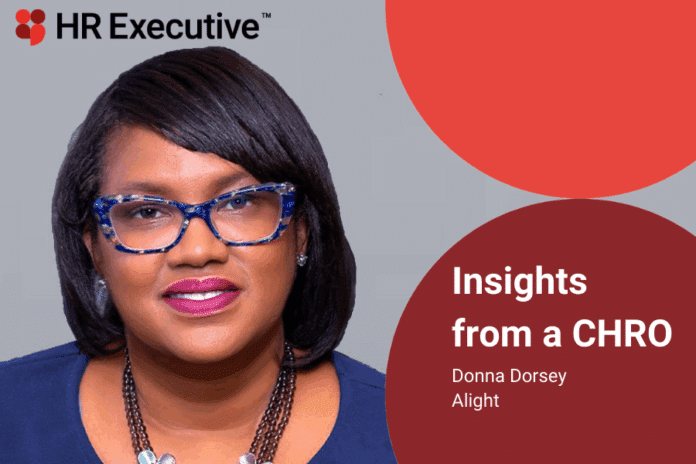
After more than 20 years at motor vehicle manufacturing company International, Donna Dorsey was preparing to step down and into retirement; she jokes that her gardening equipment was set up and ready for her. But, when a CHRO opportunity arose at Alight—a provider of human capital technology and services—she set aside the gardening gloves to dive in, as the pull to the organization’s purpose was so strong.
Dorsey had been in the role for about three months when HR Executive connected with her at HR Tech, earlier this month in Las Vegas. Dorsey says she heard directly from clients during the event about how Alight’s purpose-driven work materially impacted their lives. As she acclimates to the role, listening has become a key priority, including in how Dorsey connects with and understands the culture that supports the more than 10,600-person workforce at Alight.
Employee feedback will be key, Dorsey says, as she works to align HR strategy with organizational purpose. Here’s the vision for that work that she shared with HR Executive.
HR Executive: You have mentioned that Alight was an opportunity for alignment with purpose. What does that mean for you?
Dorsey: I had officially announced my retirement, and I was ready to go to that next phase of my life. I had my gardening stuff all out and plans for the garage. And then I got a call from Alight, and I thought, “Well, I’ll talk to them.” What Alight does is deeply personal. It goes back to why I am in HR. I really think that the way in which we all live our lives is that we come to work to provide for our families. And it only is beneficial if you’re able to provide a really good place for people to work. That’s why I started in HR. I thought, “This is the way I round out my career.” I’m deeply [invested in work] that has a lasting meaning for not just my organization, but other organizations. We’re giving back to their families.
HR Executive: How did that commitment to purpose drive your initial HR priorities?
Dorsey: I walked in saying all information is good information. I’m just going to listen. I knew what people were going to say at International before they were going to say it because I had been there for so long. But I came into Alight thinking, “I have got to hear and listen.” There’s no way that I can think that what I’ve learned in the past is going to be able to replicate it. This is a new company for me. [CEO] Dave [Guilmette] has a hugely unique vision for what the company is going to be. I really needed to listen, talk to people. I tried to basically close my eyes, go to an org chart, point to a name and start talking to people—just take in all the information.
So, for me, the priority was to just be open-minded and think about what really needed to happen to make sure that the vision for the company could happen.
HR Executive: How does Alight’s remote-first strategy influence how culture will drive that vision?
Dorsey: What I think is unique for me is that I came from a company that was mostly in the office. Here, we have a 100% remote commitment, so trying to ascertain the culture is a little bit more difficult. You can’t see it every day; you can only visually express it through Teams meetings.
The executive team even is fully remote. When we get together, it’s meaningful time together once a month, but then we’re doing an off-site coming up. At that off-site, we’re going to talk about what this culture is: Who do we want to be? What are the attributes of leadership? How will people feel it? I always say the culture is created every day by every interaction with every employee. It’s not like we can say, “Thou shalt have a culture that is … ” People have to feel it in their interactions with others.
For me, it’s going to be about getting the executive team aligned to it. That’s important, but it’s going to happen every day. We can’t just be talking about it. We have to put in place systems, processes, ways of working, how we express it through our leaders and their attributes; all of those things have to come together to have that culture.
The way I feel Dave is trying to really think about this is that we choose to work as a team. In the past, sometimes there have been silos, which every company has. He really sees us all being one team. We’re one ELT; I may be HR, but I can talk about what Rob’s doing over in Customer Relationships. We’re one team, so that culture replicated through the organization will make a difference.
HR Executive: What has the transition been like for you moving to a remote-first company?
Dorsey: It’s been really strange. I was always a proponent of flexibility. And then I found out I was remote, and I was like “Yeah!” But then it was, “Wait a minute.” Some of my team members I just met last week, and some of them had never seen each other in person, even though they have been working together for a long time. So, it’s been a change, but what I’ve learned to do is spend more time with people.
I might have decided I was going to have one-on-ones every other week, but now I have one-on-ones every week, because that way I know that I’m interacting with them, and I don’t feel rushed to get to know them. It’s important for me to know that you have a family or that these are things that are important to you, and I can’t do my one 30-minute one-on-one every other week and not randomly run into you in the hallways. I just have to be more intentional about having more interaction and spending more time with my team.
HR Executive: What role is equity playing as you shape talent processes?
Dorsey: I’m really very impressed with what Alight is doing in the inclusion and diversity space. Our leader for diversity, Xan Daniels, also owns employee experience. It’s the thinking that DEI is not this thing on the side; it’s about how we experience the workplace.
Dave is also very vocal about how important DEI is in the organization. We really look at the dynamics of this culture. We have thousands of people who are constantly on the phone with clients every single day. There’s nothing more important than the person on the other side of the phone feeling like someone can understand and relate to them, and the only way you do that is through experiences and the human touch. That makes equity so much more important.
When we’re hiring, we have interview guides and competencies and all those things, but we also think that multiple assessments will allow us to get the best people. That means we’re going to get the best diversity of people, which provides equity in the talent process. It’s not just about hiring, it’s about everyday decisions. I’m right now hiring a leader for total rewards. I want that individual to come in and look at all of the pay practices we have, all of our benefit structures: Are they meeting people where they are? That’s what the Alight Worklife Platform is all about. It’s about meeting the evolving needs of employees where they are. So, we should be doing the same thing. We always say we drink our own champagne; we have the Worklife Platform, we use all the tools around wellbeing, and it’s all about being highly personalized and equitable to what people need.
HR Executive: What is the emphasis on employee wellbeing, particularly given Alight’s purpose?
Dorsey: It’s constant. One of the first things I was worried about was listening, and the other was trying to care for the team. Alight has been through a lot in the last five years: investitures, acquisitions, and the HR team has been in a crazy little spin here. One of my first objectives was to understand where are we from a wellbeing perspective. How are our people feeling those types of things? [HR has] to feed ourselves first and make sure that we’re well, so that we can then give that same love, caring and empathy to employees. It starts with us being better.
I actually heard a story from someone who’s here [at HR Tech], who told me about how loyal they are to Alight because, in a time of severe tragedy, Alight was there for them. They said, “I don’t know what I would have done if I didn’t have that care.” The way that we can show up for our employees is by first caring for ourselves, and then when we care for them, from an empathetic lens, you can see the loyalty of our employees. You can see it in action.
HR Executive: How has your own approach to HR leadership evolved throughout your career, and how do you see that continuing at Alight?
Dorsey: From my time at International, I learned that companies are made for a purpose, a reason. This is a different purpose from my prior company. So, what does that mean for me? How do I lead differently? I think what I have learned already is that leading at Alight will make me an even more empathetic leader. I feel like I’m much closer to not just my employees at Alight but to all 35 million people [that Alight serves through clients]. It’s almost a lot to worry about. You’re literally not just caring for your employees; you’re caring for 35 million employees.
We meet with the product team, and they say, “What do you think about this?” We have the ability to influence and impact what we provide to our clients. That’s a huge responsibility, but it’s also the reason why I came. If I’m going to leave a lasting legacy in HR, it’s going to be setting up these things.
I want to talk to people—we’re high-tech and high-touch—but we’re talking to them with more data and more information. It’s a totally different HR world. I was saying yesterday, this is the best time to be in HR. There’s so much change, and we’re at the forefront of it. But it’s also a great time to be a CHRO. You can really make a difference. And I’m at Alight where we’re influencing many CHROs’ lives. That’s really cool.