

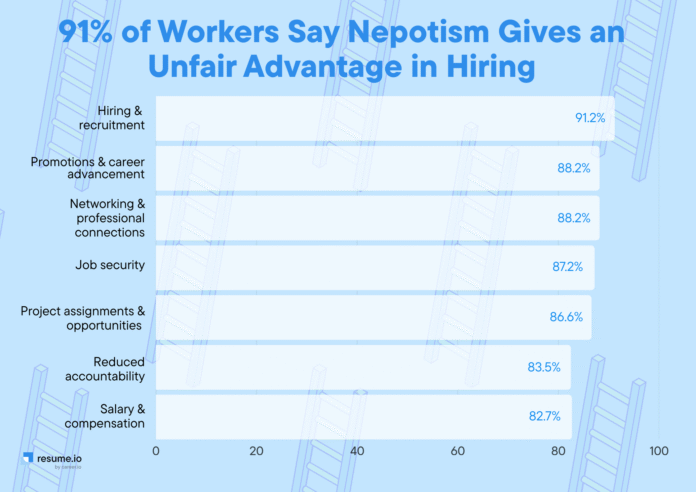
Nearly seven in 10 American workers believe nepotism is widespread in U.S. workplaces, and 45% say they’ve personally lost job opportunities or promotions to candidates with family connections, according to new research from job-seeker support platform Resume.io.
The survey of 1,000 U.S. workers reveals that 40% have been hired by companies where a relative has already worked. Mothers, fathers and siblings represent the most common family connections that opened doors.
While nepotism may not violate rules at many organizations, it can still have cultural costs. More than half of employees report that nepotism damages team morale, trust in leadership and confidence in diversity efforts, while 60% say it harms both internal culture and public reputation.
See also: HRE’s number of the day: employee morale
What counts as nepotism?
Workers showed high sensitivity to family hires across scenarios. The survey asked respondents to evaluate various situations and determine whether they constituted nepotism. The results revealed that employees broadly define the practice to include not just direct hiring of relatives but also preferential treatment in promotions, assignments and workplace policies.
The nepotism visibility problem
Family hiring isn’t happening quietly. More than half of workers say they know colleagues who landed jobs through family ties, while another 25% suspect it happens but can’t confirm it. Only one in five employees believes their workplace is free from nepotism.
The perception gap between competent hires and fair hiring practices poses a particular challenge for HR leaders. While 70% of family hires are considered good fits for their roles, according to the report, the perception of favoritism still undermines workplace culture and leadership credibility.
 “When employees believe that hiring decisions or promotions are based on family ties rather than one’s merit, it can undermine the organization,” wrote Amanda Augustine, career expert at Resume.io. “Over time, this can hurt employee engagement, team morale and even retention.”
The business impact of nepotism
Nearly 73% of workers agree that “it’s not what you know, it’s who you know” when it comes to getting hired, with Gen Z leading the pack at nearly 77%. Millennials follow at 74%, Gen X at 71% and Baby Boomers at 68%.
This widespread belief that connections leapfrog qualifications could be a challenge to employer branding and talent attraction strategies. According to Deloitte, purpose-driven concerns play a major role in career decisions: Around four in 10 Gen Z and millennials say they have turned down work assignments for ethical reasons, and around a third of Gen Z and millennials have declined job offers from employers whose values didn’t align with their own.
According to the research, employees report that nepotism damages critical business functions:
- team morale: 61%
- trust in leadership: 62%
- DEI efforts: 61%
- company reputation: 60%
- productivity and innovation: more than 50%
The data shows that nearly half the workforce may feel the system is rigged against them, signaling a potential retention and engagement crisis that many organizations have yet to recognize.
HR and nepotism
Even when nepotism is allowed in the workplace, Augustine says, HR can take steps to mitigate negative perceptions of the practice. “Employers need to demonstrate to their teams that opportunities are earned, not handed down, which is why most candidates benefit more from professional advocates than family members trying to open doors for them,” she wrote.
For employees who find themselves working alongside family hires, Augustine recommends focusing on individual performance, advice that HR teams can keep in mind if this conversation occurs in their own organizations.
When workplace concerns arise, HR professionals should be prepared for complaints to come their way. In the report, Augustine advised employees that while they can’t control how someone gained an opportunity, they can control the value they bring to the organization: “If favoritism starts affecting your work or the team dynamics, document your concerns and tactfully raise them with your manager or HR department.”

