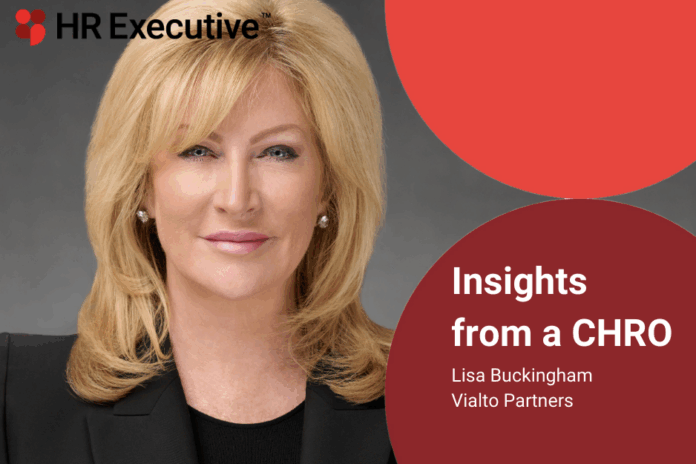
When Lisa Buckingham was named as the top-ranked CHRO on N2Growth’s Leaders40 Top CHRO Award list last year, a press statement labeled her as a “bellwether for innovation”—someone whose example peers in the profession look to as they navigate a changing landscape for HR.
Buckingham, the chief people and culture officer at Vialto Partners, credits her accolades, in part, to a “collective effort”—as she works with her team and extensive community of HR peers to stay on the leading edge. It’s more critical than ever, says the Fellow of National Academy of HR and the HR Policy Institute, for HR leaders to learn with and from one another, given heightened uncertainty and the accelerated pace of change.
Both are top of mind in Buckingham’s work at Vialto, a provider of solutions for global work, which she joined last summer, following a career of HR leadership positions at organizations including U.S. Soccer Federation, Lincoln Financial and Thomson Reuters. She recently spoke with HR Executive about pursuing HR innovation amid change in 2026.
HR Executive: Given Vialto’s focus on global mobility, how are you prioritizing connection among your own global workforce?
Buckingham: We’re a carve-out from PwC and we’re relatively new. Coming in as chief people and culture officer is pretty cool, and it gives us an opportunity. When I joined, there were a lot of return-to-office issues and questions about how we connect our leaders across 55 countries. We’ve gotten very serious about our culture transformation and gotten very serious about how we make sure that all of our employees around the globe feel like they’re one Vialto.
We’ve rolled out a strategic blueprint internally with four strategic drivers, which are really important to driving the growth of our business. And we have defined behaviors, so we’re connecting our employees with those. We have different workstreams and an acceleration group, made of about 70 key leaders across the organization who are our strategic voices.
We’re ensuring that everything foundationally in HR and talent is based upon our strategic drivers and our behaviors—performance management, how we reward, how we promote, how we recruit. It’s really an end-to-end talent journey.
HR Executive: What role do you see technology playing in connecting employees to one another?
Buckingham: You have to have the right platforms. You have to have the rules of the road on staying connected. The biggest challenge is time zone differences. We’re centralizing systems and making sure that people know how to use them, and we’re thinking about the etiquette. In this world of returning from COVID and return-to-the-office, people love to text, to use chat. Microsoft Teams is game-changing for us. But again, it’s what are the behaviors and what are we asking people to do culturally? We do remind people to pick up the phone as well. From a connection perspective, everybody communicates differently; we’re trying to make it as streamlined as possible, but also convenient from the time zones. We want visibility and transparency on everything we do.
HR Executive: How is your function helping the Vialto workforce stay ahead of ongoing change?
Buckingham: I’ve been a big part of the CHRO Association, HRPI, HR50 and I make sure I cascade any pertinent information to Vialto’s HR team. I have a team that runs data, and we make sure we’re looking at any public policy changes anywhere across the globe. We’re a tax and mobility company, so there are a lot of implications for employers there. We do a lot of cascades, and we do quarterly HR town halls. We have weekly HR leadership team meetings.
I also really push our leaders to get out there and have a voice. I’m new here, so I’ve been asking people to really think about a topic that they’re super interested in, write something about it and then come and talk to us about it. It’s really challenging people to not just stay focused internally, but also to think about becoming a thought leader in different areas. And that’s one way to upskill people.
And I’m one of the most transparent and open communicators. In my first three months, I had over 300 meetings. They were 15-minute meetings, where I met every single HR person across the globe. I wanted to find out what was on their minds, and the pace of change is a big deal to everyone.
HR Executive: How does AI fit into this conversation?
Buckingham: We have introduced some pretty cool AI training. We’re doing a huge AI transformation to empower employees with true OD skills, true change management skills. Everybody’s coming at this from different places. Some 51% of our workforce is still PwC, and we have new hires. Everybody’s at different levels of training and development and learning. Finding the most scalable training is really important to me.
See also: Worried about AI? You should be, these HR vets say
HR Executive: Where is AI being integrated at Vialto?
Buckingham: We are implementing AI in our tech roadmap; we’re a Workday house, so we’re looking at how we can leverage what they’re offering through our Udemy platform. We’re trying to use AI to reduce turnaround time for manual work, but not take away that strategic work; I really want our strategic work to be very hands-on. As an example, we recently had a long meeting with our leadership team looking at whether we’re getting the right data for our clients. We have great data in our platforms, but we’re really working hard, so can we get it easier through AI?
We’re also thinking about what we’re doing with our businesses and what they need from us. In L&D, we’re using AI-powered virtual reality role plays. That was something I dreamed about 20 years ago when I was at Thomson Reuters. It’s a safe, realistic and adaptive practice; people aren’t embarrassed as they’re learning how to use VR. Many of us have young kids who are pretty used to it, but it’s an opportunity for building skills faster in a safe place.
We’re also embedding AI into our L&D smart search. Employees can get really customized L&D for their skills, and it will also recommend what they need to work on from an upskilling perspective. We didn’t have that growing up in our careers.
The other thing is on the analytics side. We’re digging deep in that because that’s how you take the veil off of. If anybody’s worried about AI, you can show them what it can do just with analytics. And that machine is just going to keep learning more and more about our workforce and our dynamics and make us better.
HR Executive: How are you balancing the need for HR innovation with the need to center empathy?
Buckingham: We’re not just adding tools, we’re being thoughtful about how we do it, making sure we’re not losing connectivity.
This is our opportunity as architects to drive internal change, educate people, look at what is the art of the possible from an AI perspective, without losing that human touch. I want to make sure we’re empowering people to learn about AI and make sure that we’re taking the time to bring them along.
It really is having a focus on the idea that our workforce is in a far different place today. That’s really important. When we think about the impact of AI, it’s not just job eliminations. Our mindset at Vialto is about redeployment and where we can use their skills.
We’re all working differently. I can’t wait to see where we are in five years. It will be mind-blowing. Here at Vialto, AI isn’t replacing people; I want that to be really clear. It’s reshaping what people are capable of and what they’re learning.
We’re trying to create interactive ways to learn, so it’s safe and fun and it’s a shared responsibility here. We’re not telling everybody AI training is mandatory. People are going to pick up skills or not and then that will prove their journey moving forward. Finding out what people are capable of through this journey, that’s a passion for me. We’re not just in a technology transformation, we’re really in a human transformation as well. We’re all learning how to work differently. Things are being powered by technology, but we still have human-centered leadership. We still have human decision-making. Are we accelerating some of our data metrics by AI or tech? Sure. But we’re still shaping our humans in how to think and work differently. Every senior HR leader should be the architect of this.
This is a huge communications lift. Bringing people along is one thing, but it’s the myth busters—telling people what we can do, opening up the aperture and saying, “Look, this is what I learned” and sending out those examples. That way it’s not just people thinking, “There are going to be robots running around here.”
I’m not using the “future of work” anymore. I’m saying the “now of work.” The future has hit us.
HR Executive: What are some of the things you’re thinking about to help keep your HR function on the leading edge heading into 2026?
Buckingham: Are we thinking broadly enough about organizational design? Are we bringing the right people into the right area of focus with the right investment at the right time? I’m thinking about the constructs of the way we work.
The other thing that I’m thinking about is not necessarily skills gaps but a skills collapse. There are going to be some skills that are just gone. So, what are we doing?
Also, do we have invisible bias because of AI? And how do we get around that to ensure that’s not happening?
For all these things, we have to create the right governance structures and the right communication structures and then rewire the thinking of decision-making. Collaboration, power dynamics in an organization, what “good” looks like, how we communicate—it’s all changing.
HR Executive: Despite uncertainty to come, what are you most excited about for HR this year?
Buckingham: Because we’re so deeply embedded in transformation, our roles are a little bit seamless with other leaders in the organization. We’re partners in every dynamic change. It’s not like it’s just HR anymore; we’re strategic partners. That makes me really excited. I love seeing a lot of my peers taking on the AI transformation. HR is shaping the way we work in the future.