

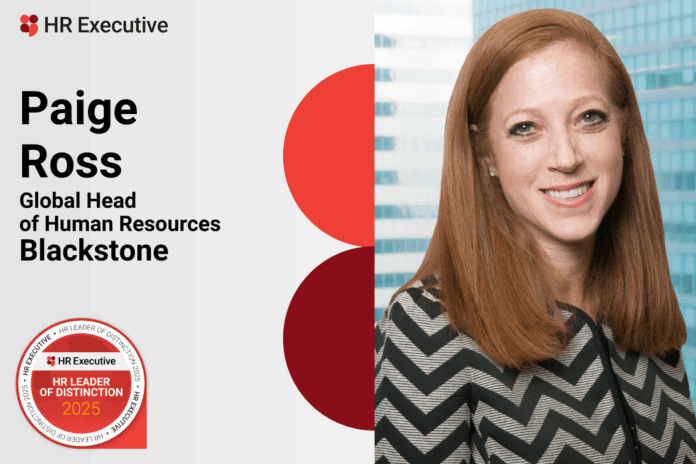

The perception of HR’s strategic potential has significantly evolved in recent years—to the point, says Paige Ross, global head of human resources of Blackstone, that HR and business strategy shouldn’t be distinct from one another.
“I don’t think of HR as having a strategy,” says Ross. “I think of the business as having a strategy—and HR is there to deliver on the strategy.”
HR is not a driver or a supporter—but rather one of the most critical forces that can enable business growth. It’s a role HR leaders need to more transparently own, says Ross. HR Executive named her the 2025 HR Leader of Distinction, which highlights excellence in HR leadership at an organization with fewer than 10,000 employees.
“The second we don’t embrace the fact that we’re key parts of building the future, we lose,” she says.
Ross says her own understanding of the interplay between talent and business outcomes helps her bring that strategic, confident HR leadership to Blackstone, the world’s largest alternative asset manager, which she joined nearly a decade ago.
An HR role model
“I see the world through a talent lens,” she says. “It’s the way I’m wired.”
That vantage point has proven critical as Ross leads her team of more than 200—and oversees HR operations for the company’s 5,000 global employees—through challenges that include building skills for the future, AI integration and a recent highly publicized shooting that claimed the life of one of its executives.
Former Johnson & Johnson CHRO Peter Fasolo, the 2022 HR Executive of the Year and a judge of this year’s competition, calls Ross a “role model for HR excellence.”
“She has a rare combination of strategic skills along with outstanding operational rigor,” Fasolo says. “Paige has earned the confidence of her CEO, C-suite, board and associates throughout Blackstone. She is a caring, confident leader who delivers for all of her stakeholders.”
Building the framework for investor success
Ross is consistently thinking long-term—especially when it comes to developing the workforce of the future.
It has long been evident what sets Blackstone’s investment talent apart: They are “really smart, talented, analytical people,” yet those who have really risen through the ranks and driven organizational success also have the ability to work across functions, with leadership and outside companies—bringing a “full-picture” view. What makes that mindset and approach possible? That’s what Ross and her team set out to uncover last year with a deep dive into the capabilities that define investor excellence at Blackstone.
Related: Behind the ‘people-led, tech-powered’ Walmart: Meet the 2025 HR Executive of the Year
Ross’ team interviewed more than 40 leading investors and company leaders to define “what success looks like” and the key differentiators that help the best investors consistently find it. That effort evolved into “Beyond the Numbers,” a framework that identifies how investor success can be achieved through balancing technical and non-technical skills.
“When we look at the future leaders of the firm, they will need to be extremely well-rounded because the world is changing so fast,” Ross says. “Being smart and analytical and knowing the numbers is critical, but not enough—leaders also have to have strong EQ.”
Beyond the Numbers is an effort to build the ideal investor capabilities—what Ross calls the “ingredients for success”—across all employee programming.
These include 360s, promotion processes, leadership development and through “every level and activity” of learning and development curriculum.
“I have a very strong philosophy: If you put a message in one place and not every place else, it gets lost.”
Paige Ross’ personalized approach to learning
With the same forward focus, Ross led the Talent Development team to develop a sponsorship program for high-potential junior investors. The recently launched Cultivate equips such rising talent with senior sponsors, coaching, networking opportunities and access to business strategizing sessions in a nine-month program.
Such work landed Blackstone on the list of finalists for an inaugural HR Executive HR Icons Award for Excellence in Talent Development. (The firm is also a finalist for an HR Icons award for Best Workplace Culture.) Winners will be named next week in Las Vegas at the HR Icons Awards Evening, where Ross and HR Executive of the Year Donna Morris of Walmart will also be recognized.
Given that the initiative is nomination-based, Ross’ team has worked closely with senior leaders to emphasize their critical role in employees’ development.
“We had to make sure that the people at the most senior levels know who their top talent is—at every single level in their group—and that they are accountable for making sure that they’re successful,” she says.
More mentoring and customization
The program complements other advancement efforts, including Accelerate for mid-level professionals and Next Level Leadership for new hires and recently promoted talent. Since both programs launched four years ago, 70% of Accelerate participants have been promoted, while 77% of Blackstone mid- and senior-level employees have participated in Next Level.
See also: Why HR must embrace a new era of learning and development
The team looked to these two programs to shape the design of Cultivate, with particular attention to personalizing the learning experience, which prompted a greater emphasis on mentoring.
“I think the biggest thing that we learned is people really want an individualized experience,” Ross says. “Everybody has their own learning journey, and so a big part of it is, what do we offer everybody in these groups, and then what do we customize?”
AI: It’s coming ‘fast and furious’
Personalizing employee experiences is also a priority in how Blackstone embraces AI for HR.
“The more we [in HR] can leverage AI, the more it gives us the ability to use our brain power to help employees—as opposed to taking it away,” Ross says, noting she views AI and the innately “human” aspects of HR as complementary, not competing.
“It’s about saying, ‘Where can AI be additive? Where can it be helpful?’ ” she says. “I get excited about what I think it can do.”
At Blackstone, the HR team is leveraging AI at both the rudimentary and advanced levels, Ross says. The tech is assisting HR with combing through thousands of data points to draw insights—from engagement surveys, employee feedback, 360s and more.
“It helps us pull together common themes we should be paying attention to,” she says.
Blackstone is in the midst of an 18-month journey of exploring the most effective use cases for AI in HR. For instance, the function is looking at AI-powered bots for employee benefits assistance.
Just the beginning
The project was driven by a focus group Ross led with HR business partners exploring common touchpoints with employees, including during open enrollment and year-end processes. She found that employees tended to go to HRBPs for very similar questions.
“There were these typical 10 questions everyone was asking. And I’m thinking, ‘OK, if we’re getting these from everybody, why don’t we have a bot that can answer them?’ ”
The experience, she says, highlights just how expansive the opportunities are.
“We’re about halfway through, and I think we could identify another 50 projects,” she says.
AI is coming “fast and furious” to the function, Ross says, and it’s important for leaders to recognize that this is the tip of the iceberg.
“I just don’t think we’re anywhere near knowing the capabilities [of AI for HR],” she says. “I think we’re going to be surprised in two years that we still haven’t identified everything where we can take advantage of AI from an HR process perspective.”
‘Feedback is a gift’
As Blackstone charts its path forward in a quickly changing world of work, employee feedback will remain integral.

Ross says she personally prioritizes and acts on her team’s insights, an approach that mirrors the companywide commitment to giving a voice to employees. For instance, when an engagement survey pointed to some concerns among HR professionals about communication, Ross organized a team call, focus groups and more to dive into the issue.
“Here I thought, ‘I’m communicating all the time, leaders are communicating all the time.’ But what we found is that they didn’t necessarily want to hear from me; they wanted to know what’s going on globally,” she says.
Her recruiting team, for instance, may have wanted a bigger-picture look at talent development efforts in London or programs in Hong Kong.
Last year, Ross rolled out the “Friday Five,” a weekly email to her entire team recapping highlights and accomplishments from across the global team. Each of her leaders is accountable for compiling each group’s highlights. The team effort, she says—which occasionally includes personal photos, such as from Ross’ daughter’s wedding—has gotten “phenomenal” feedback and serves as a means of promoting team connection and collaboration.
“This isn’t what I’m delivering, it’s what they’re all delivering, and they should all be proud of each other,” Ross says.
Scores on this year’s engagement survey among her team increased, particularly around recognition and culture.
“Feedback is a gift,” Ross says.
HR’s balance between ‘courage and humility’
As she has progressed in her career—which also included leadership roles at Centerbridge Partners, Pfizer, Avon Cosmetics and PepsiCo—Ross has increasingly recognized just how influential employee feedback can be for HR leaders.
“As I’ve gotten more senior, I’ve wanted more input, and I’ve had to openly solicit it,” she says.
Ensuring feedback is candid can be a challenge for leaders, she notes. Ross coaches senior leaders to be aware that they may need to be proactive to get transparent feedback.
“The more senior you get, the more people want to say, ‘Oh, you’ve got that right.’ And it’s like, maybe, but maybe not,” she says. “People might tell you what you want to hear versus what you need to hear.”
That reality has shaped Ross’ own approach to HR leadership—as she focuses on “creating the environment where people know I want to know the truth.”
“It surprises people that I ask a lot because I really do believe the only way I get better—and I always can get better; we all can always get better—is if people are transparent and candid,” she says. “As leaders, it’s really important to always welcome [honest feedback]—because the second you shoot it down, you never get it again.”
That approach underlies Ross’ philosophy on effective HR leadership: It’s a balance, she says, between “courage and humility.” HR leaders need to be confident in their convictions but gracious enough to know that “we don’t know everything,” which can enable quicker decision-making and the ability to flex and pivot in a changing world.
“I believe I have to lead that way, and I have to train my people to lead that way,” Ross says. “It’s a huge responsibility we have to do.”
Culture through tragedy
It’s a responsibility that was put to the test this summer, as Ross and other company leaders had to suddenly navigate the highly publicized death of one of their colleagues, Wesley LePatner, who led Blackstone’s real estate investment trust business. She was among four people killed in a shooting in New York City in July.
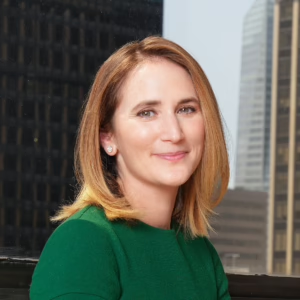
Ross credits CEO Stephen A. Schwarzman and President Jonathan Gray for the firm’s “immediate” and transparent response to employees.
“We pulled out all the stops to make sure everybody got the support they needed,” Ross says. “It was about meeting everybody where they were.”
This includes webinars and crisis-management resources, including on talking to children about the incident. Webinars are being offered through September, and if employees continue to want such offerings, Ross says, they will be made available.
“We’re also still providing counseling services,” she says. “We’ll do it as long as people need it.”
As tragic as the event was for those who knew LePatner and employees who were in the building during the incident, Ross says, it illuminated the culture at the company.
Schwarzman: Paige Ross’ communication sets her apart
“It was the worst day, but the best of Blackstone came out,” Ross says. She personally made more than 50 phone calls to check in with affected employees, as did Schwarzman, Gray and other company leaders.
“Seeing people come together really highlighted the kind of people we have,” she says. “They work hard and they care a ton, and that’s what came out.”
Ross’ own capacity to care for the Blackstone workforce is integral to her leadership, and her success, Schwarzman wrote in her nomination letter.
“What truly sets Paige apart is her leadership style. She is an exceptional communicator who leads with transparency,” he wrote. Schwarzman says Ross consistently “keeps a great pulse” on her team and the organization.
“Paige is not just an exceptional HR leader; she is an exceptional person,” Schwarzman wrote. “Her vision, dedication and ability to inspire those around her have had an indelible impact on Blackstone.”
3 key elements of HR leadership success
HR Leader of Distinction Paige Ross says the HR function is a critical enabler of business growth. To approach that potential confidently, Ross says, HR should remember that:
- Consistency drives growth. By embedding skills profiles throughout all employee programs and creating learning initiatives across levels, Ross says, Blackstone has been able to multiply its talent successes. Creating frameworks that can be applied consistently enables HR to scale quickly.
- Humility is critical. Ross’ approach to leadership centers on remaining humble, a goal that she says leaders, including those in HR, may need to reinforce within themselves continuously. By genuinely seeking and considering feedback, HR is better-prepared to design talent strategies that resonate with the true needs of employees.
- Agility and empathy can work together. HR may need to pivot frequently and be ready for the unexpected, and leading with empathy can make that work possible. When Blackstone lost a colleague in a tragic shooting, Ross says, the leadership team had to act fast to support the workforce, and it made those quick decisions by prioritizing what was best for their people.
In addition to the HR Icons Awards Evening on Sept. 15, Ross will be recognized at the Human Resources Policy Institute’s Fall Summit at the Questrom School of Business at Boston University on Oct. 23. Learn more about HRPI and its members-only summit.
