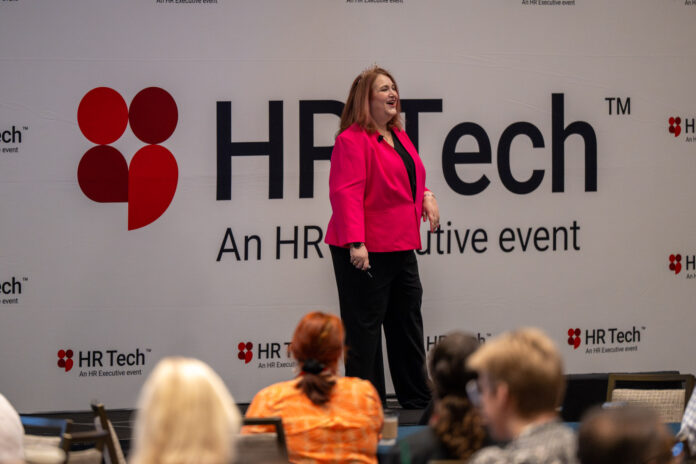
As AI takes over the HR agenda, it’s reshaping everything from perceptions of the function to tech spending. Those are among the takeaways from Sapient Insights Group’s 28th Annual HR Systems Survey, key findings of which were released Thursday at HR Tech in Las Vegas.
Stacey Harris, chief research officer and managing partner at Sapient, noted that AI adoption now stands at 31% at the nearly 5,000 organizations surveyed—representing 30 million workers—up from 23% last year. At the same time, 39% increased HR tech spending this year.
“AI is forcing everyone to rethink their models,” she said.
Top takeaways from the Annual HR Systems Survey
Shifts in HR tech spending
Overall, 37% of organizations are planning to increase their current HR tech budget, while 7% project a decrease.
“Are we investing in HR tech more? No—but more than last year,” Harris said, noting, however, that spending has trended downward in recent years—with a 29% drop since 2020.
This year, a big emphasis is being placed on investments in intelligent tools.
AI in HR
What role is AI playing in HR functions? There are significant differences based on organization size, Harris noted.
Last year, about 40% of enterprise organizations were using AI at any level in HR, a figure that jumped by about 5% this year. Adoption soared at small and mid-market organizations, which saw 50% and 42% increases, respectively, in the use of AI in HR since 2024.

The survey found that outcomes are best when organizations leverage AI in HR in standalone formats—like ChatGPT—alongside AI embedded into HR systems.
“Organizations are not using embedded AI as much as you would think,” Harris noted, with respondents most likely to report embedded AI in their HRMS—though still only at 12%.
One eye-opening finding, Harris added, was the share of HR professionals using “bring your own” AI to do their personal work, not actual HR processes: 81%. Of those, less than a third report their company is paying for the tool, and 14% are paying for it themselves—meaning the rest are using free AI.
“I’m going to just leave that there and let you understand how dangerous that is in the market,” she said.
HR’s strategic potential
When it comes to how respondents think their HR functions are perceived, about 51% said they’re looked to as strategic—a slight dip from last year’s survey, and a few points shy of the 55% goal Sapient had been pushing for by 2025. That includes a small decrease in how strategic HR respondents consider their own function.
“As AI came into the market, all of us had to reassess our strategy, rethink our roles in the organization,” Harris said. “As executives and business leaders are saying, ‘How do we do this?’ we had to take a step back.”
Yet, perceptions of HR from outside the function tell a slightly different story: “Your colleagues don’t agree with you,” Harris said.
Fifty-nine percent of CEOs believe their HR organization is strategic, alongside 54% of IT leaders—a significant increase from last year.
“When AI hit the market, IT realized, ‘I’ve got to talk about workforce resources; that’s not what I do. Who do I turn to?’ That’s us,” Harris said.
IT leaders are “partnering now more with HR than ever”—and those that aren’t, Harris advised, need to do so fast. That relationship will be critical to driving talent and business outcomes from AI implementations.
See also: What it will take to be a true ‘future-ready’ org?
Opportunities to gain strategic ground
Other areas where HR can concentrate to elevate its strategic profile include finance organizations and boards of directors—both of which are “struggling,” Harris said, to view HR as a strategic function.
Use data to tell that story, she advised, something not enough HR functions are doing well. The survey found big jumps in the number of organizations not doing any executive-level HR reporting this year, particularly around learning.
“We knew [DEI reporting] was going to be down, but we were not expecting learning to be even lower,” Harris said.
Many HR leaders concentrate on communicating the function’s value to the CEO—but they already see it.
“Stop worrying about getting that seat at the table,” Harris said. “Instead, make friends with your finance team. Make sure the board knows what you’re doing.”