


Forty years ago, employees who needed help with their benefits would have placed a call to Barbara or Bill over in HR. Today, the “HR” that employees experience is likely to comprise a diffuse constellation of chatbots, internal HR staff, outsourced service providers, cloud-based HR platforms and more.
As HR functions increasingly digitize and outsource in these ways, it’s critical to track how employees perceive and experience the quality of HR services. Net Promoter Score (NPS), a traditional measure of customer loyalty, can be a handy way to get a quick reading of how employees are experiencing HR service delivery. After breaking down cross-industry data related to NPS in HR, here is an overview of how NPS measures can help HR make better data-driven decisions and provide guidance for how to use these measures effectively.
Understanding Net Promoter Score
Traditionally, NPS asks customers to rate the likelihood that they would recommend a company’s products and services to others, with zero being the lowest score and 10 the highest. To calculate their NPS scores, organizations subtract the percentage of detractors (customers assigning a score from zero to six) from the percentage of promoters (those who rated the company a nine or 10). The resulting score is a number ranging from -100 to 100.
While organizations use NPS to measure customer loyalty, many HR functions also gather and track employee Net Promoter Score (eNPS) by asking employees to rate the likelihood that they would recommend their employer to others. When paired with additional follow-up questions or used as part of a broader engagement survey, eNPS can help HR identify opportunities to improve the employee experience.
Measuring HR service support with NPS
NPS can also serve as a quick and easy way to measure the quality of HR service delivery by asking employees or end users: “On a scale from 0-10, how likely are you to recommend X to a colleague?” (In place of X, use the name of the HR service used or accessed; name of the HR service center; name of an HR services agent, etc.). Whether you are measuring the impact of a new tool or assessing the need for training among your HR staff, NPS has a lot of value to measure the quality of HR customer service support for at least three reasons:
- Leaders will be familiar with NPS, and it is easy to understand.
- It is relatively quick and easy to collect.
- It can be easily administered at the point of service.
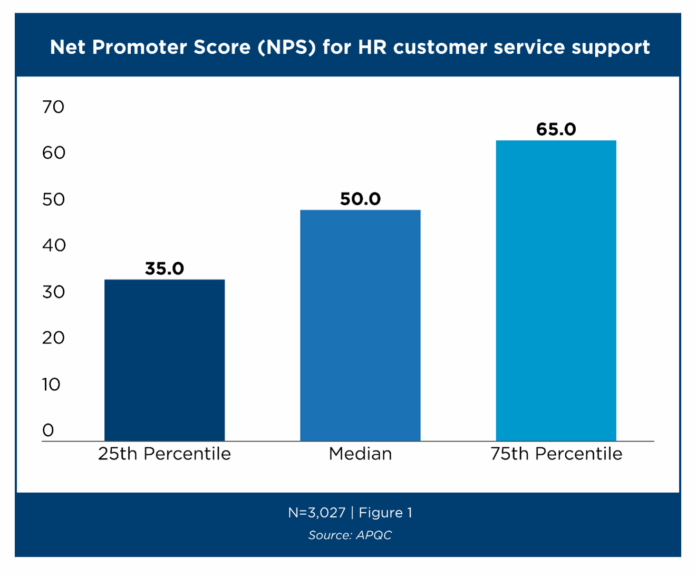
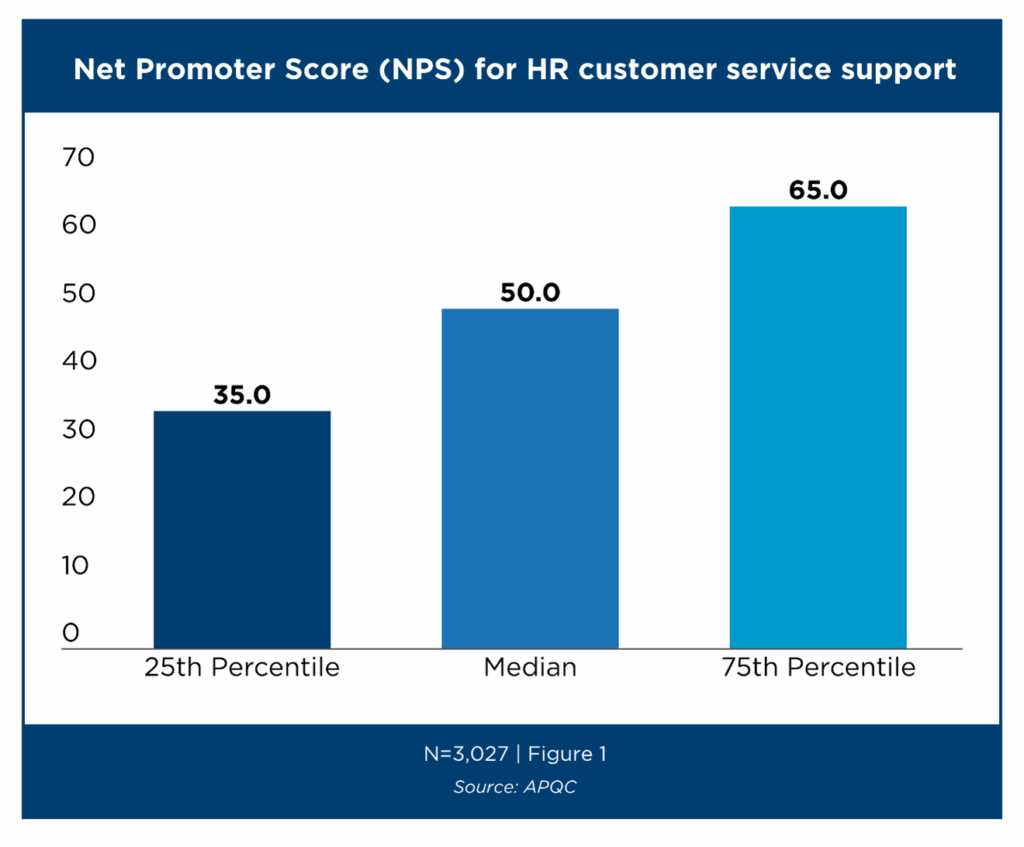
Data from our recent HR automation survey of more than 3,000 respondents provides a good cross-industry snapshot of NPS for HR service delivery. We found that HR functions have a median NPS of 50. The lowest-performing organizations (in the 25th percentile) have an NPS of 35 or lower, while those in the 75th percentile have an NPS of 65 or higher.
These numbers will look different from one industry to another. For example, we found that government, military and telecom organizations tend to have lower HR NPS scores, with a median of 45 in each case. Benchmarking within your industry can provide more context about what “good” might look like for your organization.
Practical applications for HR teams
NPS can serve as an outcome measure across a range of HR services, processes and activities. For example, if you are adopting a new automated platform for expense reimbursement, measuring NPS scores before and after implementation could serve as a high-level indicator of end-user satisfaction. NPS could also be applicable to use cases like:
- Providing accountability for service level agreements. NPS can be part of a set of measures that HR uses to assess the quality of outsourced HR services and to keep vendors or service providers accountable.
- Internal benchmarking. Comparing NPS measures from across HR (i.e., recruiting, onboarding, payroll, benefits) can help you discover best practices and opportunities for improvement.
- Supporting talent management in HR. NPS scores can be an indicator of where you need more training, resources or staff in HR.
- Comparing and making decisions around digitization. NPS can help illuminate which approaches benefit from the human touch versus automation to help HR functions think about the most effective approach in each case.
- Building the case for new technologies or upgrades to existing systems. Low or declining NPS scores could be an indicator that your systems environment needs a change or an upgrade.
Building a complete HR service dashboard
NPS can tell you that employees or end users are satisfied or dissatisfied, but on its own, it doesn’t provide any context about why your scores look the way they do. For that reason, it’s helpful to include an open-ended follow-up question with your NPS questionnaire. For example:
- What is the primary reason for your score?
- What could have been done to improve your experience?
You should also put these scores in a broader context that includes other factors like cost, efficiency and customer resolution rates. Tracking NPS along with these other measures will provide a more comprehensive picture of HR service performance and help you see where you may need to make tradeoffs between competing priorities (for example, between cost and quality).
Improving low NPS scores
Low NPS scores can be an important indicator that you have opportunities to improve specific HR processes or services. Use follow-up surveys or focus groups to diagnose specific pain points and consider your options.
Many of the same steps that companies take to improve their NPS with customers will also be relevant for HR services. Addressing comments from detractors is an obvious place to start, but don’t gloss over comments from people who are highly satisfied with their HR experience. You can use them to help you understand what’s working well for people and find best practices from other areas that you can try.
Making NPS work for HR
NPS is not a silver bullet, but it is a valuable addition to HR’s measurement toolkit. It offers a quick read on service quality that can help HR leaders make data-driven decisions about where to invest, improve or innovate with limited resources. It will also be familiar to business leaders and easy for them to understand when HR needs to make the business case for improving HR processes or services.
As with any outcome measure, HR leaders will need to put NPS scores in a broader context to make them useful and actionable. A balanced scorecard that measures cost and efficiency helps ensure that improvements in one area (such as satisfaction) don’t come at the expense of other priorities. It’s also critical to collect and address feedback from real people and end users about how they experience HR services and support.
In the end, HR service quality isn’t just about numbers; it’s about building trust, loyalty and a better employee experience.
