HR has its seat at the table. Now, how to use it?
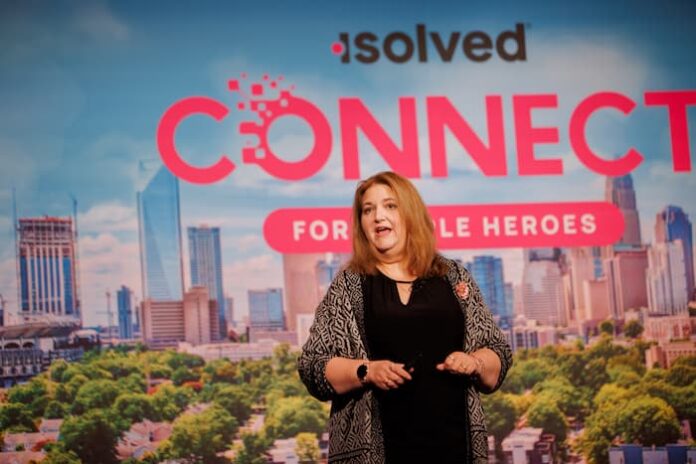
The path toward more strategic HR was a primary question Stacey Harris, chief research officer and managing partner at Sapient Insight Group, dove into this week during a keynote address at isolved’s Connect for People Heroes event in Philadelphia.
Harris argued that HR professionals are perhaps the most strategic people in a company, particularly amid ongoing AI advances. HR leaders are skilled at balancing short- and long-term visions, are often more data-fluent than most other execs and are skilled at managing assets that don’t always do what they expect—an important consideration in the age of AI.
“People don’t always go left when we tell them. We have experience working with things that don’t always do what we expect them to,” Harris said. “What we do, and how we do it, is so much more relevant in today’s market than it’s ever been.”
A swinging pendulum
Yet, strategic HR is still a goal, not yet a reality at many companies. Key findings from Sapient’s 28th Annual HR Systems Survey, unveiled at HR Tech in September, found that about 51% of leaders surveyed said they have a strategic HR function, a slight dip from last year, including among HR professionals themselves.
While CEOs and IT hold more favorable positions about HR’s influence, the finance function was most negative.
“That influence piece, that buy-in—that’s what folks are still struggling with,” Amberly Dressler, senior vice president of brand and experience at isolved, told HR Executive.
During the HCM provider’s customer road shows, held in about 100 cities over the last three years, Dressler says isolved has heard directly from many practitioners about their workforce’s day-to-day needs—how important earned wage access could be, for instance—but also how they struggle to move the ball forward.

“They still go back to their employer and it falls on deaf ears if they don’t have that influence,” Dressler says. Growing into a more strategic HR function is a particular necessity—and challenge—today, she adds, as labor market shifts are putting more power back in the hands of employers. “The pendulum is swinging back, so it becomes even harder to get influence for what employees need.”
Yet, businesses would be doing a disservice to not recognize the value of strategic HR, Harris says.
Sapient’s research found that businesses that view their HR function as strategic outperform those that don’t across HR, talent and business outcomes—including productivity, performance and market share.
“But you don’t get that by minimally investing in HR,” Harris says. “You don’t get that by just calling HR ‘strategic,’ but by giving HR the things they need to do the strategic work. It’s a conversation every CEO needs to understand.”
Assessing how strategic your HR function is
Harris points to a number of red flags that could suggest HR’s influence in an organization is lacking:
- You’re “going it alone”: It’s critical for HR professionals to have support and tools—such as the ability the outsource tasks or even offload ideas onto colleagues.
- Payroll consumes your time: If you’re spending more than 15% of your time on payroll, your ability to work strategically is significantly hindered.
- Your HR tools aren’t “employee-friendly”: The workforce should be able to easily access information and HR support, including via mobile.
- Your data isn’t driving decisions: Often, executives don’t know how to ask for the HR data they need, so HR needs to be proactive about getting it in front of them. “If executives don’t see data in some format, they’re not valuing the time you spend on that work—and they’re definitely not valuing the technology you’ve invested in,” Harris says.
How to approach strategic HR more effectively
What are the most strategic HR organizations doing? Harris offers 4 actionable places to start:
1. Lead change—don’t let it lead you
For the first time in five years, Harris says Sapient is seeing more organizations invest in change management, driven by AI. Without that forethought, she says employees will create their own relationship with AI, which could be risky. And without providing guidance to the workforce and recommendations for leadership, top brass will think HR is “not interested” in leading the transformation of work to keep up with AI.
2. Plan for positions—then, hire for roles and skills
Given how quickly work is changing, consider workforce planning from a position perspective—not a “person perspective,” Harris says. For instance, if one individual leaves the organization and the company decides not to replace them, that person’s work doesn’t go away simply because they did. Similarly, look for candidates with widely transferrable skills that can extend to other positions over time.
3. Elevate time and scheduling
Time tracking can be “miserable but necessary” and shouldn’t be hard to use for employees and managers. For instance, if an employee forgets to clock out, a time-consuming, complex intervention by a manager drags down the experience for both and reflects poorly on the employer. Often, operations takes over time and scheduling tasks, but they should be squarely in the wheelhouse of HR, Harris says. “If you’re not handling it, you don’t have the data. And that can help you from a workforce planning perspective.”
4. Humanize absence and leave management
Culture, and not regulations, should drive policies and processes around time off, Harris says. “It makes a difference for how strategic HR is seen.”