



HR teams at the forefront of automation are already operating at a level that many organizations still wish they could reach. Only about 1 in 4 HR functions in APQC’s research (28%) have advanced to the highest levels of automation maturity, moving beyond basic automation to more sophisticated, knowledge-based and AI-enabled capabilities. These early adopters are still a minority, but they show what is possible when automation becomes a strategic enabler rather than a set of disconnected tools.
Compared to HR functions that are earlier in their automation journeys, these mature teams spend far less time on transactional work, earn higher HR performance ratings, close skill gaps more quickly and deliver stronger customer experiences for employees and managers. Their experiences offer three lessons that can help any HR team strengthen its automation journey:
- Start where the payoff is clear
- Plan carefully to avoid common pitfalls
- Build the foundation for automation before adopting the technology
See also: How to make automation work for you
Start where the payoff is clear
Facing growing pressure to deliver more value with fewer resources, HR leaders need to be selective about where they automate first. Fortunately, early adopters provide a good example of the areas that you may want to target. Figure 1 shows the most common areas of HR automation for these leading HR teams.
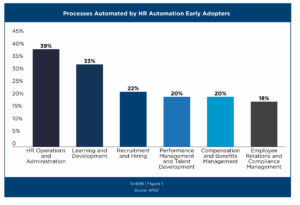
To illustrate how mature HR functions put automation into practice, the following list highlights the two most common automation use cases for each core area identified in Figure 1:
- HR operations and administration: Managing HR reporting and analytics; managing employee profiles
- Learning and development: Learning analytics and reporting; new hire training
- Recruitment and hiring: Job posting; identifying candidates
- Performance management and talent development: Providing predictive analytics and modeling; talent pipelining and development
- Compensation and benefits management: Managing performance-based compensation; managing benefits enrollment and administration
- Employee relations and compliance management: Track and manage employee acknowledgements; attestations of company policies
These use cases show that early adopters tend to approach HR automation with two broad priorities in mind:
- Reducing or eliminating highly manual work for staff
- Building capabilities for data-driven decision making
Delivering on both of these priorities will help you shift HR from a support function to a strategic partner that drives value for the business. For example, analytics can help you determine which learning and development approaches are paying off and where staff might be struggling, so you can focus on what works best. Automating areas like benefits administration enables your staff to focus on strategic questions like these instead of spending their time on employee paperwork.
If you’re unsure where to start, look for work that is both time-consuming and repetitive or that generates valuable data. Automating these areas will give you early wins that build the foundation for taking on broader challenges and putting the right support structures in place as your automation strategy grows.
Steer clear of the common pitfalls
Early adopters not only help us understand what to automate, but also where things are most likely to go wrong. Below are the top five challenges that slowed automation efforts, introduced unnecessary rework or undermined early momentum. Anticipate and plan for these challenges in advance so they don’t derail your automation efforts.
Lack of access to reliable data
Nearly all early adopters (99%) struggled with inconsistent or incomplete HR data. Without clean, standardized data, even simple automation can misfire or produce conflicting results. Addressing this early means ensuring data is entered the same way across HR systems, setting clear rules for how information gets updated and routinely checking for errors so issues don’t grow worse over time.
Infrastructure that cannot support automation
Most early adopters (91%) ran into issues with existing systems that could not support the automation tools they selected. For example, a recruiting tool might screen candidates efficiently but require staff to re-enter the same information elsewhere. These gaps can cancel out the efficiency gains automation is meant to deliver and make it harder to scale efforts over time.
Automating the wrong workflows
Nearly two-thirds of early adopters (63%) found that they had automated processes that were low-value, poorly designed or not ready for automation. This led to disappointing results and forced teams to revisit work they had expected to modernize.
Automations that fail across environments
Sixty-two percent of early adopters reported that automations performed well in one location or business unit but broke down in others. These inconsistencies force teams to create workarounds that erode efficiency and reduce trust in future automation projects.
Skills shortages or gaps
More than half of early adopters (55%) realized that their teams lacked some of the skills needed to support and sustain automation, like basic data literacy and familiarity with how automated workflows operate.
Strategizing around these issues early will give you a clearer roadmap and help keep automation efforts focused and stable.
Lay the tracks, then the train
Early adopters of HR automation show us that success isn’t just about choosing the right tools. Before automation can deliver real value, HR needs a solid foundation that makes early projects work and later projects easier to scale. Process standardization and optimization is a key part of that foundation. In fact, 77% of early adopters said they focused on standardizing or streamlining HR processes to prepare for automation. We explored this step in detail in a previous article, and it remains essential. But early adopters also show that standardization alone is not enough.
Once manual tasks are removed through automation, HR teams need to be ready for more analytical, consultative and strategic responsibilities. Sixty-nine percent of early adopters invested time and effort in shifting HR staff to this type of higher value work, often supported by long range development plans that helped people grow into new expectations gradually rather than abruptly.
Early adopters also built reliable ways to track progress and continually improve automated HR processes. About 6 out of 10(65%) created a continuous improvement loop for automated HR processes to capture lessons learned, evaluate outcomes and feed improvements into future automation efforts. These efforts help to reduce rework and keep automation projects on track.
Nearly two-thirds of early adopters (64%) developed a change management strategy to support their automation efforts. An effective change management strategy helps managers, staff and employees understand what is changing and why. It should also create space for people to share concerns, provide timely training and ensure that leaders reinforce the purpose behind each automation effort.
Together, these steps create the groundwork that makes HR automation more strategic, scalable and sustainable.
Keep moving your automation journey forward
HR automation is a proven path to better performance, a stronger employee experience and a more strategic role for HR. Early adopters show that meaningful progress begins with choosing the right starting points, anticipating common challenges before they grow and laying the groundwork that makes each new automation easier than the last.
Every HR team can take similar steps today:
- Start where the payoff is clear
- Watch for the obstacles that have slowed others down
- Build a foundation before you adopt automation technology
With a thoughtful approach and a long-term view, HR leaders can create the conditions where teams do their best work, employees get the support they need and the business is ready for whatever comes next.
